The following weeks after we found out what Dean was allergic to were intense. The first week, we had to give him Benadryl 5 out of 7 days because he had some sort of minor allergic reaction (hives) despite our elimination of the known allergens. Four of those times, daycare called me in the middle of the work day. Whenever I saw its number pop up on my phone, my stomach dropped because I thought they were calling 911 again. I’m in meetings about 6 hours a day and am often running them or presenting. I didn’t know whether to drop everything and step out or if they were calling about random stuff, Dean fell and hit his head but he’s OK, etc. I finally had to tell them to call my work cell for emergencies only, like he’s having a severe reaction, and to call my desk phone for all other issues.
Of course, when your kid is living off of Benadryl, you think, “Are their other things he’s allergic to that we just don’t know about still?” This is ridiculous! I started to keep a diary of what he ate and symptoms to see if there were any patterns. After that, we religiously introduced only one new food at a time, testing it 4 full days, before we introduced the next item.
I also called the allergist with lots of questions, mainly to gage if administering Benadryl 5 times during the course of a week was just what life was going to be like now or if this was unusual. She was anything but helpful. She was condescending and rude and was practically yelling at me on the phone. I almost hung up on her at one point (of course, there would have been some words said there too!). She could have cared less that I was concerned, worried, and confused. I told Matt that step one was to find a new allergist.
It felt good, however, to make some decisions and start putting things into motion over the next few weeks.
Decisions
– Keeping wheat, eggs, peanuts, and tree nuts in the house for the rest of us to enjoy.
– Feeding Dean food that’s been processed in a facility with those allergens.
– Not feeding food that’s been processed on shared equipment with those allergens.
– Trying, as much as possible, to eat all organic and non-GMO food.
Our approach was that we didn’t know what his level of allergic response was so we thought we’d try the less conservative approach and if that didn’t work, we could always tighten up. If we went the other way, we’d never know. So far, it’s been working. My hands are constantly dry from all the hand washing that goes on around here but at the same time, our floors are immaculate because they are always vacuumed!
Action Plan
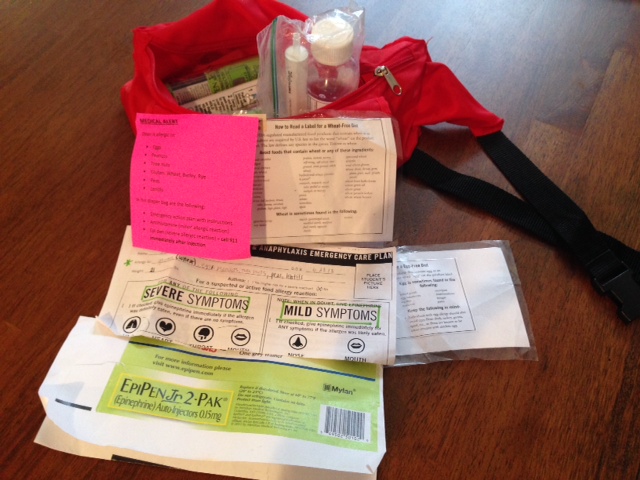
– Put together a small emergency “care” kit with antihistamine, dropper/cup, 2 epi-pens, practice epi-pen, and documents below. (We put ours in a nylon fanny pack labeled with his name so it can easily be grabbed when we’re switching bags, etc.)
– Posted a list of ingredients that contain specific allergens in the kitchen for quick reference. FARE (Food Allergy Research & Education) provides lists of the common 8. (We put them inside our pantry door.) (Note: If you are avoiding all gluten, add barley and rye to the wheat list.)
– Prepared an emergency response plan with antihistamine amounts and emergency contacts, and put copies in my purse, emergency “care” kit, and a kitchen drawer for babysitters.
– In the emergency “care” kit, included a medical alert note* (contents at bottom of this post) printed out on bright neon pink paper so someone can grab it quickly in the event of an emergency. It listed the food allergies and what to do in an emergency in 3 quick bullet points. I also put it a copy in my purse. In the care kit, I also included a photocopy of the epi-pen box with expiration date, and the allergen ingredient lists mentioned above.
– Taped the bright medical alert note on the door side of both car seats. I got this idea from the concept from the C.H.A.D. (Children Have An Identity) stickers both the kids have on their car seats so in the event that we or another driver dies in a car accident, emergency personnel will see the medical alert and know what not to feed him.
– Moved all foods that were safe for Dean to eat to one pantry shelf. Taking information I learned from sanitation class, we made ours the top shelf so no allergen food can fall onto the shelf.
– Created a quick way to mark safe foods so we wouldn’t constantly be re-reading labels all the time, especially once the complex multi-ingredient foods started. I do a triple check of all ingredients – twice in the grocery story and once when I’m putting groceries away, and if OK to eat, put my initials next to the ingredient list. This is helpful to our babysitters because they don’t need to be trained to read all the ingredients and doesn’t put as much pressure on them. (I read that you could also use stickers.)
– Since we keep allergen foods in the house, we invested in a good small vacuum cleaner to keep near the kitchen. Matt found this amazing Dyson one. It’s expensive but worth every dollar, and we saved money by purchasing a refurbished one.
– Designated one counter area free of all allergen foods. Dean’s foods are prepared in this area to avoid cross-contamination.
– Added a reminder to my “to do” list to reorder new epi-pens near their expiration date.
– Found a new allergist (yay!) who we really like.
The action plan at daycare is deserving of its own post so I won’t get into any details now.
My advice to anyone going through this (or parenting in general) is to use other people’s guidance as a starting point. You know your child best and what he or she needs. Trust your gut, and go with what feels comfortable. Everyone has a different level of risk. If something doesn’t feel right, make adjustments. Eventually something will stick.
* MEDICAL ALERT
Child’s name is allergic to:
- List items
- items
In his/her location, e.g. diaper bag are the following:
- Emergency action plan with detailed instructions
- Antihistamine (minor allergic reaction) – 5 mL
- Epi-pen (severe allergic reaction) – call 911
immediately after injection directly through
clothes
 Our Life and Food